Is a Rain Chain Supposed to Touch the Ground in Ravenel?
The last few inches of a rain chain decide whether it guides water quietly or splashes it against your foundation.
Is a rain chain supposed to touch the ground?
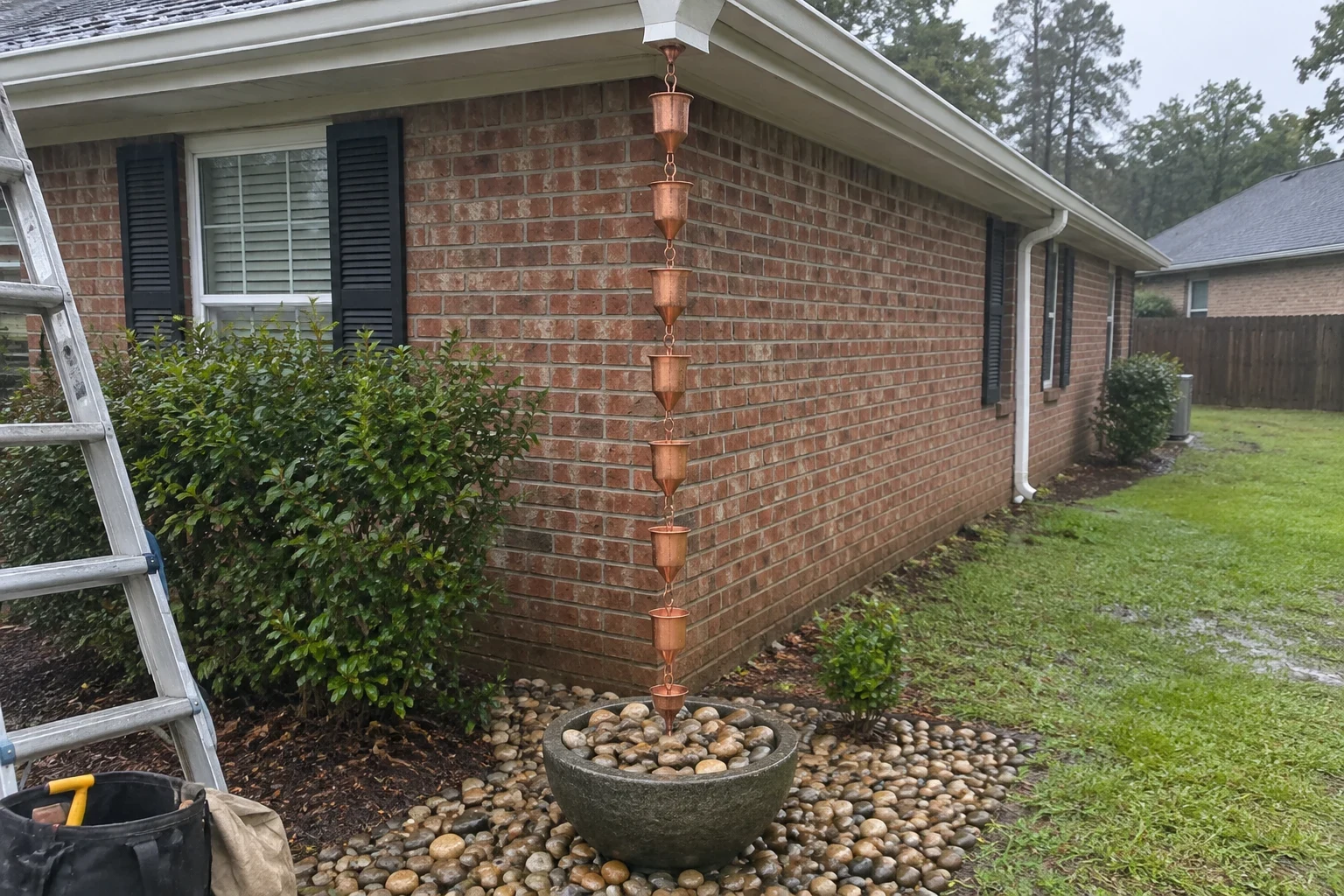
No. A rain chain should stop a short distance above the ground, usually just above a basin, splash stone or gravel bed. That small gap keeps the chain from kinking and lets water drop into a spot built to take it. In windy weather, anchor the bottom so it can't swing. Questions? (843) 612-1021
Why a small gap works better than full contact
A rain chain works by surface tension. Water clings to the links or cups and follows them down, so the chain only needs to deliver water to a catch point, not to the soil itself. When the chain piles up on the ground, the bottom links fold over each other and water starts spraying sideways instead of running straight down.
A chain resting in dirt also stays wet. Copper and aluminum both hold up well outdoors, but the bottom links sitting in mud will stain, collect debris and, on painted or coated chains, wear unevenly. Leaving the chain hanging free lets it drain and dry between storms.
- Less splash onto siding, brick and the lower course of trim
- No coiled or kinked links at the bottom
- A cleaner finish on copper as it ages to its natural patina
- Easier to inspect and adjust the hang
How far above the ground should it end
Most chains look and work best when the last link sits an inch or two above the rim or surface of whatever catches the water. If you are using a basin, the chain can dip just into the bowl so water lands in the center. Over a gravel bed, ending a few inches above the stone keeps the fall short enough that it does not scatter.
Length is easy to get wrong when ordering. Measure from the underside of the gutter outlet to the top of the basin or stone, then subtract the gap you want. Many chains can be shortened by removing a link or two, which is a better fix than letting extra length pool on the ground.
Anchoring the chain for wind and heavy rain
Not touching the ground does not mean swinging loose. Summer thunderstorms and the windy edge of tropical systems can push a free-hanging chain into the wall or window trim, and a chain blown sideways sends water where you do not want it. A light anchor at the bottom keeps everything lined up.
The usual approach is a short stake or ground anchor set in the center of the basin or gravel bed, with a small length of wire or a clip holding the last link. The chain stays taut and plumb, yet the bottom link still sits clear of standing water. Some decorative basins have a built-in anchor point for exactly this reason.
- Ground stake through the center of a basin or gravel bed
- A small clip or wire tie on the last link, snug but not tight
- Check after big storms that the stake has not shifted in soft soil
Where the water should land
The more important question is often not the chain but the spot beneath it. A rain chain moves the same water a gutter outlet does, and in a hard Lowcountry downpour that is a lot of water in one place. If it lands on bare soil next to the foundation, it will dig a hole, splash mud onto the house and soak the ground you want to keep dry.
Plan for a catch point that slows the water and moves it away. A sturdy basin, a bed of river rock or a dry well all work, and the ground around it should slope away from your home. Ravenel's flat, low-lying lots make that slope worth checking, because water that has nowhere to go will sit against the foundation.
When we fit a rain chain, the same small crew handles the gutter outlet, the hang and the basin setup, so nothing gets left half done between visits. We also look at whether the gutter run feeding that chain is pitched correctly, since a chain cannot fix water that never reaches the outlet.
- Decorative basin, filled with stone so it does not overflow or tip
- River rock bed at least as wide as the splash zone
- Dry well for spots that collect a lot of roof area
- Ground graded to carry overflow away from the foundation
More questions about rain chains
Something not covered here? (843) 612-1021
Do rain chains overflow in heavy rain?
Some splashing is normal during a downpour, especially with link-style chains. Cup-style chains carry more water with less spray, and a correctly sized gutter outlet helps keep the flow centered on the chain.
Can I put a rain chain on any gutter?
Most gutters can take one, but the outlet needs to be sized and placed to feed the chain well. If your gutters sag or hold standing water, it is better to handle gutter repair first so the chain gets steady flow.
Is copper or aluminum better for a rain chain?
Copper weathers to a soft brown and green over time and is heavier, so it hangs steadier in wind. Aluminum is lighter and holds a painted finish, which suits homes where you want the chain to match existing trim.
Talk through your rain chain setup
Tell us where you want the chain and what the ground below looks like. A free consultation covers chain style, length, anchoring and the catch point, so the water lands where it should.